
Squatters Displaced Five Months Ago Face Uncertain Future
english.ratopati.com · Mon Sep 21 13:15:00 GMT 2026
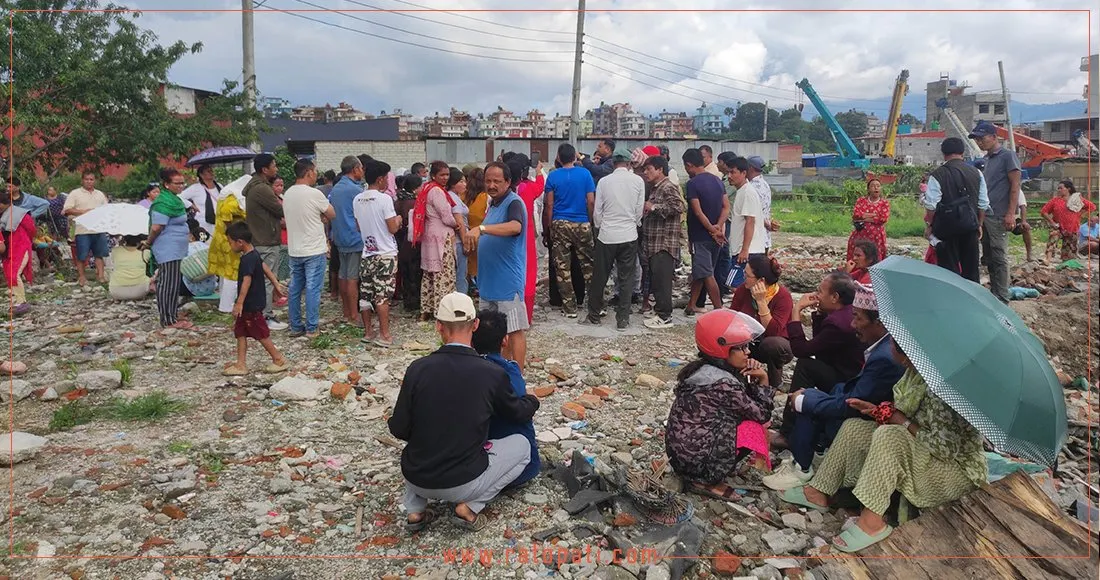
Kathmandu. It has been 5 months since the homes of squatters and unorganized residents who had been living by the riverbanks of the Kathmandu Valley for years were taken away. On April 12, bulldozers were run along the river corridors of the capital, including the Bagmati, under the direct instruction of Prime Minister Balen. Hundreds of families displaced by the removal of unauthorized settlements along the Bagmati and other riverbanks were temporarily moved to various 'holding centers' in and around Kathmandu. Five months after the settlements were demolished and people were moved to temporary shelters, the issue of their sustainable resettlement and permanent management remains uncertain. Policy Failed Before bulldozing the squatter settlements, the government had put forward two policies. Under the first policy, those who had land and houses elsewhere in the country but were living on the riverbanks of Kathmandu under the guise of squatters were to be sent back to their original places. Under the second policy, it was announced that the state would find suitable places and permanently manage those who are truly landless and squatters with dignity. Until both these processes were completed, the displaced were to be kept in holding centers, arrangements were to be made for those who wished to stay with relatives or in rented rooms, and Rs 25,000 was to be provided to each family as initial management expenses. Furthermore, it was assured that Rs 15,000 per family per month would be provided as relief until a permanent residence was finalized. The biggest failure of the government's assurance is seen in the financial assistance promised to the displaced. While the government did distribute Rs 25,000 to about 1,863 families in the initial phase of settlement demolition, squatters were completely abandoned thereafter. The announcement of Rs 15,000 per month has remained only on government records. Citizens who have been living a difficult life in holding centers for five months, unemployed, homeless, and helpless, have not received any further assistance from the state. Dr. Anand Bhat, Executive Chairman of the Empowered Integrated Bagmati Civilization Development Committee, admits that the Rs 15,000 could not be provided. According to Khagendra Bahadur Bist, a sociologist at the Bagmati Committee, the relief amount promised by the government to the displaced families has been stopped due to technical reasons. 'Rs 25,000, which the government promised to provide in the first phase, has already been received by 1,863 families. However, the Rs 15,000 for house rent (for three months) and the relief amount for some families who did not receive the Rs 25,000 have not yet been distributed,' he said. According to sociologist Bist, the distribution of funds was halted because the budget was frozen at the end of the fiscal year. He stated that the committee has now requested a new fiscal year budget from the ministry and that relief will be distributed to the remaining squatter families as soon as the budget is released. Statistics of the Completely Landless Being Sought Another major weakness in squatter management and a counterproductive step by the state is the verification process. Normally, before removing any settlement, the real squatters and 'occupiers' should be identified. However, here, the search for who is a real squatter has begun only after bulldozing and pushing citizens onto the streets. The Land Problem Resolution Committee has sent the land verification requests for 388 families among the displaced in the holding centers to the concerned districts and local levels. According to Sanjeev Kumar Sah, information officer of the committee, the central system shows that 65 families have land in their names, while 18 families have incomplete details. For the rest, since the old records of land revenue offices across the country are not online, investigations are being conducted at the local level by sending files. 'The policy is that the squatter claim of anyone found to have land elsewhere will be automatically rejected,' he says. While the policy is correct, the entire process shows that the state's preparation was zero. Officials of the Land Committee themselves admit that it will take months to get a clear picture of how many people will be identified as real squatters and receive land, as all local levels are working on a rotational basis. Although some local levels have committed to identifying and providing land, none of the displaced have been able to relocate to new land so far. Khagendra Bahadur Bist, a sociologist at the committee, stated that the process of land verification and investigation of those displaced families is also progressing in coordination with the Land Problem Resolution Committee. Out of the previous 388 families, the details of 264 have reached the committee, and upon investigation, it was found that 52 of them have no land anywhere in the country (completely landless). Similarly, files of another 51-52 individuals with incomplete documents have been sent to their respective local levels to ascertain the facts and fill out forms. The first phase of the investigation will be finalized only after the recommendation from the local level is received. Bist stated that the committee is managing the daily food and clothing for those in the holding centers and there are no problems in that regard. What is the Condition of the Holding Centers? The Empowered Bagmati Civilization Integrated Development Committee has stated that it is managing 108 squatter and unorganized resident families displaced from the Bagmati riverbanks in three holding centers. According to Khagendra Bahadur Bist, a sociologist at the committee, displaced persons from the 7 holding centers that were previously in operation have been selected and are now housed in Bode, Kharipati, and Ichangu. According to the latest data, 262 citizens from a total of 108 families are dependent on the holding centers: 60 people from 21 families in Bode, 105 people from 42 families in Kharipati, and 97 people from 45 families in Ichangu. The committee stated that those directly removed from the Bagmati riverbank (including the Rato Pul area) have been placed in Bode and Kharipati, while the Ichangu holding center exclusively houses highly vulnerable families such as single women, young children, pregnant and lactating mothers, the sick, and the disabled. Chairman Bhat of the committee argues that the reduction in numbers is due to the process of sending those identified as genuine to designated locations and the exclusion of those with duplicate identities. However, the government is being criticized for the inhumane conditions in the holding centers, the uncertainty of the future, and the extreme despair towards the state, forcing many displaced people to find alternatives themselves. As Dashain approaches, there is no enthusiasm on the faces of the citizens in the holding centers. While they used to celebrate Dashain with joy in their homes, this time they are facing the festival living a refugee-like life. Chairman Bhat of the Bagmati Civilization Development Committee has stated that there will be no problems with food and drink for the families in the holding centers during Dashain. He claims that instructions will be given to the canteen to arrange for special and better meals than usual during Dashain, and he will speak up if necessary. He also mentioned that sarees were distributed during Teej and blankets before that.
Read full story at source (english.ratopati.com)