
Former PM Oli Performs Hindu Rituals Amidst Criticism of Ideological Deviation
english.ratopati.com · Mon Oct 19 14:15:00 GMT 2026
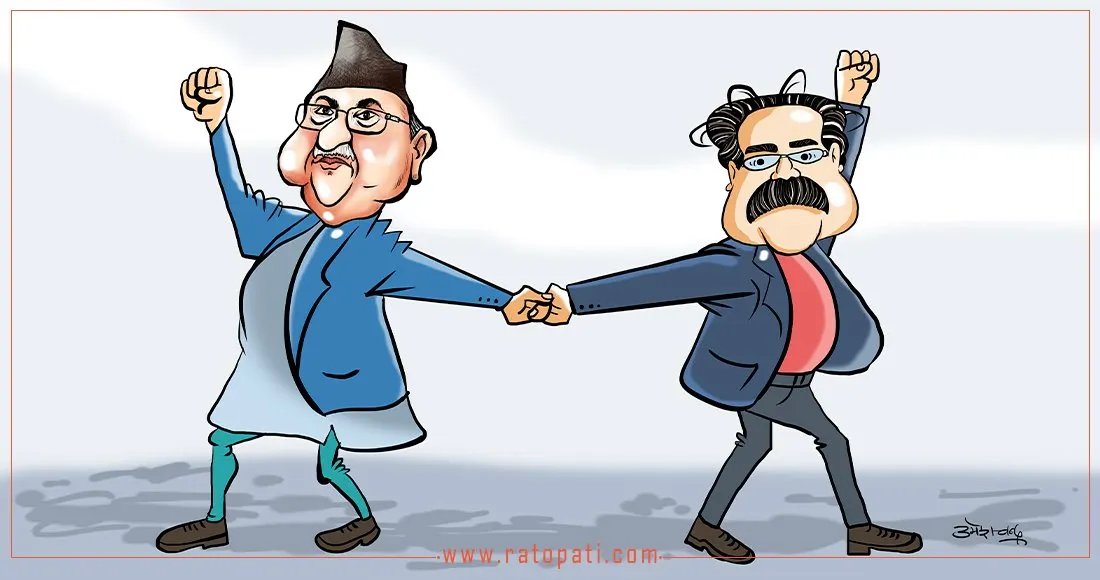
Kathmandu. Former Prime Minister and CPN (UML) Chairman KP Sharma Oli performed 13 days of mourning rituals according to Hindu customs after the death of his father Mohan Prasad. Mohan Prasad passed away on February 29 at the age of 97. Following Hindu traditions and wearing white clothes, Oli is currently observing the mourning period (one year). This has led to accusations that Oli has confirmed the ongoing criticism that most of Nepal's 'communists' and 'communist parties' have deviated from the Marxist philosophy of dialectical materialism. Trilochan Dhakal, a communist leader, states that Oli, the chairman of the largest leftist party in the country based on electoral mandate, does not exhibit communist conduct. He analyzes Oli's act of wearing white clothes for a full year as pure superstition. Dhakal says, 'KP Oli wearing white clothes is superstition. If it's superstition, then he will do it. People perform mourning rituals and have stopped wearing white clothes. But he is wearing completely white clothes. When a person dies, the soul also dies, it does not become a ghost. Therefore, there is no need to perform pindadan.' Having been ousted from power due to the Jenji movement in August 2082 BS, he suffered a major setback in the elections held last February. In those elections, Oli was defeated by a wide margin in his own constituency, Jhapa-5, by Balendra Shah, the former mayor of Kathmandu Metropolitan City. His party also faced its biggest defeat in history. Having been suddenly pushed to the streets from power, Oli became homeless. The Jenji movement activists had destroyed his ancestral homes in Tehrathum, Jhapa, and his house in Balkot, Bhaktapur, by burning them down. While observing his father's mourning period for suppressing the Jenji movement during his tenure as government head, Oli was arrested on April 14 from his private residence in Gundu. Having lost his mother at a young age, he was an active participant in the famous Jhapa Revolt of 2028 BS. Oli was one of the main leaders of the Jhapa Revolt. Many claim that Oli, who spent 14 years in harsh prison life, is not a communist at all. Taking over the leadership of UML in 2071 BS, he successfully became the Prime Minister of the country four times. After the leftist alliance secured a massive majority in 2074 BS, Oli, who became a powerful Prime Minister for the second time, could not complete his full term. Due to internal disputes, the party eventually split. Oli, who became Prime Minister for the fourth time in June 2081 BS in alliance with the then Nepali Congress President Sher Bahadur Deuba, had to pay a heavy price. The party reorganization task force led by UML Vice-Chairman Ram Bahadur Thapa 'Badal' concluded that his working style caused great damage to the party and the country. However, Oli, expressing dissatisfaction with the report prepared by the task force, did not even allow it to be presented at the Central Committee meeting held on October 8. Analyst Dhakal accuses Oli's character of being spiritual rather than Marxist. 'Oli is not a dialectical materialist, he is a spiritualist. That's why communist parties have collapsed. What remains of a communist party after abandoning Marxist principles?' he questioned. In 2050 BS, after the death of CPN (UML) General Secretary Madan Bhandari, his wife Bidya Devi Bhandari was nominated by the party as a candidate in the by-election while wearing white clothes. In the by-election held on January 25, 2050, in Madan's constituency, Kathmandu-1, Bhandari defeated former Nepali Congress President Krishna Prasad Bhattarai. In the mid-term elections of 2051, Bhandari was elected from Kathmandu-2. Notably, in recent times, Nepal's leftists appear to be influenced by India's Prime Minister Narendra Modi. There is discussion in political circles that Nepal's leftists may try to maintain their dominance in party and power through religion and politics, similar to Modi. Modi has succeeded in becoming Prime Minister for three terms from the staunchly Hindu Bharatiya Janata Party (BJP). Oli also performed a special puja at the Pashupatinath Temple during his second term as Prime Minister to retain power. In April 2078 BS, on the occasion of Ram Navami, he arranged for the installation of statues of Ram and Sita in Ayodhyapuri, Madi, Chitwan, along with a chariot procession from the Prime Minister's residence in Baluwatar. It is alleged that Oli engaged in religion-politics for votes in Nepal, a country with a majority of Hindu followers. According to Lekhnath Neupane, a leader of the Nepali Communist Party, Oli might have worn white clothes after his father's death to gain public sympathy. He alleges that not only Oli, but no one in Nepal is a communist based on party affiliation. 'We don't have any communist parties by party affiliation. I don't see any communist parties in Nepal institutionally in terms of their ideology, principles, conduct, and behavior. Elections have spoiled all of us. If you don't observe mourning rituals, you won't get votes, so you have to. We have to offer pindadan every year. Where did the father go after dying? Where did the mother go? There is no account of what was done while alive, but pindadan must be done after death,' Neupane said. 'If you don't do that, you won't get votes. If we go to parliament wearing normal clothes, we won't get votes, so we have to wear Daura-Suruwal. Chhetris have to wear Kajipeti on their waist. The matter has moved towards communist leaders who have earned some money wearing ties.' Pushpa Kamal Dahal 'Prachanda', who fought the armed war for 10 years, is also on the same path. Pushpa Kamal Dahal 'Prachanda', who led the Maoist armed struggle for 10 years, also appears to be attracted to religion-politics. He led the armed rebellion in 2052 BS to overthrow the old royal regime and establish a new people's democratic power, but after coming to the peace process, he has been accused of deviating from communist ideology and principles. After coming to the peace process in 2062/63 BS, Prachanda became Prime Minister three times. In terms of popular mandate, the Communist Party of Nepal (CPN) led by him is the second largest leftist party. Although he became Prime Minister with unprecedented results in the 2064 Constituent Assembly elections, he has been marginalized from national politics by the 2082 elections. Prachanda, who plunged into the people's war without performing mourning rituals after his mother's death, had been celebrating Dashain with his father Mukti Ram after coming to the peace process. He did not perform mourning rituals when his father died in October 2068 BS. Having lost his daughter Gyanu in 2070 BS, son Prakash in 2074 BS, and wife Sita in 2080 BS, Prachanda is among the leaders who have faced the most family tragedies. However, apart from mourning his family losses, Prachanda did not participate in mourning rituals according to Hindu traditions. But, during his visit to India as Prime Minister on May 19, 2080, Prachanda performed a special puja at the Mahankaleshwar Temple in Ujjain, Madhya Pradesh. During that time, he donated 108 kg of Rudraksha and Rs 51,000 brought from Nepal. This new avatar of Prachanda was widely debated in political circles at the time. Criticized for his religious practices, he claimed to respect the faith of Hindus. Not only that, to demonstrate his firm belief in religion, he performed puja at the Pashupatinath Temple on May 27, 2080, immediately after returning from India. Before that, it was widely discussed in political circles that he performed buffalo puja for planetary peace. Prachanda, who walks around dressed in 'tie-suit', recently broke the continuity by wearing 'Daura-Suruwal' during his third term as Prime Minister. Who is a Communist? Former Prime Minister and former Maoist leader Dr. Baburam Bhattarai did not perform mourning rituals after the death of his father Bhoj Prasad. Bhattarai's father passed away in February 2082 BS. His brother Shivaprasad performed the mourning rituals for his father. Bishwabhakt Dulal 'Aahuti', General Secretary of the Scientific Socialist Communist Party of Nepal, insists that no one is a communist. He accuses Oli and Prachanda of having the same character. Aahuti said, 'There are no communists in Nepal. Those who possess non-communist characteristics cannot be called communists. Oli and Prachanda have the same character; they were in the same party. Those who have fallen from communist ideology and principles do such things. Communists respect culture, not religion.' However, analyst Trilochan Dhakal says that compared to Oli, Prachanda and Baburam Bhattarai appear to be more revolutionary. 'Compared to Oli, Prachanda and Baburam appear revolutionary. Prachanda did not perform mourning rituals for his father, mother, wife, or son. He did not perform pindadan, but he mourned. This does not mean he did not mourn at all; mourning means observing grief,' Dhakal said. 'It is wrong to liberate ancestors after death through pindadan. After a person dies, the soul also dies. What need is there for pindas for the dead? There is no need at all. Prachanda and Baburam did not do that. They did not just do that.' Dhakal clarified that while Marxist philosophy is the same worldwide, how one understands it differs. He briefly analyzed what Marxist philosophy is. 'Marxist philosophy is dialectical materialism. Materialism is the idea that consciousness is born from matter. The soul is born from the body. The process of development – the formation of the body, the world, creation, destruction – is based on dialectics, Marxism said. First, development occurs through the struggle and unity of two opposite elements. Second, the new is established by negating the old. Third, development occurs through qualitative change as change progresses – these are the laws of dialectics. Dialectical materialism is Marxist philosophy. Anyone who does not follow this philosophy is not Marxist, and therefore cannot be part of a communist party.' Clarifying that Marxism is class-based, he accused those in Nepal who are called communists of being leaders of exploiters and oppressors. 'They protect the interests of big smugglers, contractors, parasitic capitalists, and bureaucratic capitalists,' Dhakal said. A contradiction is seen in the ideology of Nepali communist leaders involved in the class liberation movement in recent times. As humans are social beings, it is natural to have faith in social values, norms, beliefs, religion, or culture. However, even supporters of communism are surprised by the contradictory behavior of leaders who claim to be true followers of Marx, Lenin, and Mao. Marx himself interpreted religion as opium. He said that religion is like an intoxicating substance that temporarily makes people forget their suffering and pain, distracting them from fighting against real social injustice. Marxism in Nepal Inspired by this Marxist principle, the Nepal Communist Party was born in 2006 BS. In 2030 BS, Ramnath Dahal, Netra Ghimire, Biren Rajwanshi, Krishna Kuinkel, and Narayan Shrestha, who rebelled against the Panchayat rulers, were killed. The rebellion was thwarted after the arrest of Jhapa Revolt leaders including Oli, CP Mainali, and RK Mainali. The Maoist armed rebellion, which lasted for 10 years, ended with the 12-point agreement in 2062 BS. Both these movements were influenced by the historical dialectical materialism propounded by Marx and the Communist Manifesto propounded by Marx and Lenin. Approximately 17,000 people lost their lives in the Maoist people's war. Communist leaders who dreamed of establishing a people's democratic state through class struggle, leading to socialism and then communism, are accused of ideological deviation in recent times. A few months ago, Professor Krishna Pokharel explained that the contradictory character of Nepali communist leaders has made even Marx look foolish. He analyzed that there can be no theoretical explanation for abandoning principles and being attracted to religion-politics. 'There can be no theoretical explanation for this. This is essentially making Karl Marx himself look foolish. What Marx himself propounded is being made to look foolish in the name of Marx. There is no need for further discussion on this,' he told RatoPati. Following Oli and Prachanda, other leftist leaders are also becoming attracted to religion-politics. The number of people participating in religious programs, visiting yoga centers, building relationships with saints and mahants, participating in foundation-laying ceremonies, inaugurations, and auspicious timings according to religious rituals is increasing. Whatever the reason, the main reason for the deviation among communist leaders is the lack of philosophical consistency, argues leftist leader Ram Karki. Karki states that philosophy is needed to remain consistent in one's beliefs through study and practice. He alleges that all communist parties are electoral parties, and they resort to religion to maintain their weak ground. 'The deviation among communist leaders is due to a lack of philosophical consistency. Philosophy is needed to remain consistently in the same belief through study and practice. Nepali leaders lack philosophical continuity. There are no programs other than elections. There are no programs to awaken the people,' Karki analyzed. On June 17, 2081 BS, Oli, who entered into a 7-point power-sharing agreement with former Nepali Congress President Sher Bahadur Deuba, told the then Prime Minister Prachanda at the Prime Minister's residence in Baluwatar that they would go to 'heaven and hell' together. It was due to this 'heaven and hell' illusion with Oli that Prachanda's government fell. Analyst Dhakal states that communists are materialists and therefore do not believe in imaginary concepts like God, religion, heaven, or hell. 'Communists are materialists. They connect every argument with the laws of science. Communists do not believe in imaginary concepts like God, religion, heaven, or hell. They only believe in things proven by science. Materialism and spirituality are different subjects,' he said. Cultural expert Om Dhaubadel analyzes that those who believe in conservatism and superstition cannot be communists at all. 'Communists do not believe in any supernatural powers like shamans, witches, ghosts, or God. They do not believe that their ancestors cross Baitarani after death, go to heaven or hell,' he said. 'Instead, they try to establish progressive customs and beliefs in their place. However, there is no shortage of people here who take the sick to shamans instead of hospitals, donate cows after a person dies, offer pindas in the name of ancestors, and call themselves true communists. Those who appease ghosts, read horoscopes, and perform rituals call themselves communists. According to Marxist principles, they are not communists, but followers of spiritual philosophy.' Cultural expert Dhaubadel believes that looking at the communist politics of Nepal, religious existence and religious issues are currently being discussed comparatively more. Although there was religious faith in the past, its discussion has increased in the current context, he understands. Dhaubadel adds, 'After Madan Bhandari put forward the concept of People's Multiparty Democracy, the basis for advancing communist ideology according to the changed political environment was created. However, religion is not the only aspect in politics. Many other components and dimensions of society also play a role. Education, policy, values, culture, and other social aspects are equally important.' He clarifies that since religion, customs, and culture are interconnected in society, the tradition of wearing a Janai or completing other rituals according to religious customs after the death of a family elder is a part of culture. 'The issue of Oli wearing white clothes should also be viewed in conjunction with our social and cultural context. However, it may not be appropriate to view the matter of him wearing it according to family customs solely in conjunction with political ideology,' he said. 'It may seem like a contradiction in society when communist leaders adopt religious customs. This is because there is a perception in society that communists are materialists and do not believe in religion. However, materialism also needs to be understood in its true philosophical sense.'
Read full story at source (english.ratopati.com)