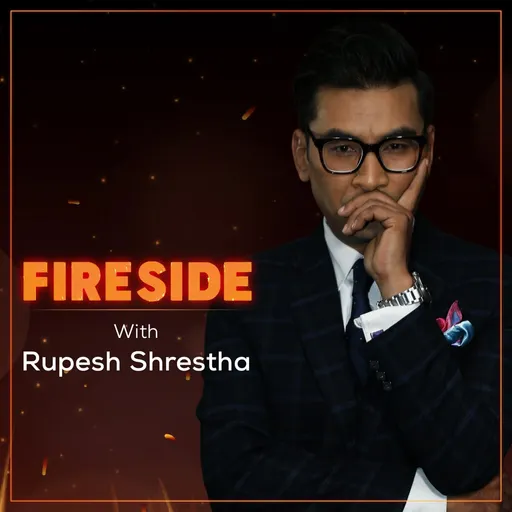
Podcast
Kantipur Sounds
16 episodes · en
Fireside is Kantipur Television's flagship talk show, airing every Monday at 9 PM. For over two decades, it has served as a trusted platform for in-depth discussions on Nepal’s most pressing socio-political issues. Hosted by renowned journalist Rupesh Shrestha, Chief of the News Department at Kantipur TV, Fireside features influential guests from political leaders to public figures who are held accountable through thoughtful and hard-hitting conversations.
Sep 18, 2026 · 50 min
Note to listeners: This episode is part of the 'Fireside Legacy' archive series, recorded at Baluwatar on March 18, 2024 (Chaitra 5, 2080), when Pushpa Kamal Dahal 'Prachanda' served as Prime Minister. In March 2024, after completing one year in office, Prime Minister Pushpa Kamal Dahal 'Prachanda' made a dramatic political shift by ending his alliance with the Nepali Congress and forming a new governing coalition with CPN-UML and the Rastriya Swatantra Party (RSP). In this candid Fireside interview with Rupesh Shrestha, Prachanda unpacks the internal frictions that led to the decision, including electoral vote-transfer failures, the Koshi Province leadership crisis, and ideological divergences at the NC Mahasamiti meeting over secularism and the peace process. Addressing critics who label him "unstable" and "opportunistic," Prachanda provides a philosophical defence of his dynamic leadership style, famously declaring, "As long as I live, there will be upheaval in this country" . He argues that taking calculated risks and adjusting course is essential to safeguard republicanism, federalism, and social justice. Key Highlights: The Anatomy of a Coalition Shift: Why the 2023–2024 alliance with Nepali Congress broke down over Koshi Province politics, vote transfers, and NC Mahasamiti debates. The "Upheaval" Philosophy: Prachanda’s response to accusations of political instability and his belief in continuous dynamic political evolution.
Sep 15, 2026 · 54 min
Marking one year since the historic Gen Z Movement of Bhadra 2082 and amid the recent Rasuwa Bhote Koshi flash floods, former Home Minister and Senior Advocate Om Prakash Aryal joins Fireside with Rupesh Shrestha. Aryal reflects on his extraordinary 365-day cycle, from an anti-corruption campaigner on the streets to Home Minister facilitating a historic election, then back to his legal practice in the courtroom. In this deep-dive interview, Aryal discusses the implementation of the Karki Commission Report, the organised violence and "bullet biker" infiltration of Bhadra 24, the legalities surrounding the detention of former PM KP Sharma Oli and former Home Minister Ramesh Lekhak, and former Chief Justice Sushila Karki’s "motherly" guardianship during the political transition. Most significantly, Aryal issues a stern warning to Prime Minister Balen Shah and the current administration regarding "Digital Fascism": ruling through online fear, character assassination, and social media intimidation creates a dangerous environment where those in power ultimately become fascism's final victims. Key Highlights: The 365-Day Transformation: Navigating the roles of a street campaigner, interim Home Minister facilitating elections, and practicing advocate. The Karki Commission & Bhadra 24 Vandalism: Unpacking the investigation into organised infiltration, state vacuum, and the mystery of the "bullet bikers." Rule of Law & Due Process: Legal scrutiny over the detention of former PM KP Sharma Oli and former Home Minister Ramesh Lekhak without formal charges. Leadership in Crisis: Former Chief Justice Sushila Karki’s role as an interim "motherly" guardian preserving constitutional continuity. Disaster Response & Human Dignity: Evaluating state coordination in the Rasuwa flash flood aftermath and why governance must centre on equal citizenship. The Danger of "Digital Fascism": Why using social media algorithms, intimidation, and character assassination as tools of statecraft inevitably consumes the rulers
Sep 8, 2026 · 55 min
Guest: Manish Jha, Member of Parliament, Rastriya Swatantra Party (RSP). Recording/Broadcast Period: August 2026 (Shrawan 2083) Episode Description: In the aftermath of the Falgun 2082 general elections, the Rastriya Swatantra Party (RSP) finds itself in an unprecedented position of power, commanding a near two-thirds majority. However, despite this massive mandate, the government faces significant "turbulence" in service delivery and economic stability. In this revealing episode of Fireside, RSP’s own MP Manish Jha steps into the role of the "internal opposition". Known for his data-driven and logical arguments, Jha deconstructs why the government he represents is struggling to meet public expectations. From the famous "Black Sunglasses" metaphor, challenging the Prime Minister to step out of his VIP bubble and see the ground reality, to the controversial role of non-state actors within the Prime Minister's secretariat, Jha offers a candid post-mortem of the administration's first few months. Jha also addresses internal party dynamics, revealing for the first time why he voluntarily declined a ministerial post and how a lack of consultative discussion is leaving top leadership "lonely at the peak". Key Highlights: The "Turbulence" Realisation: Why Jha believes that if the "plane" of government is still shaking after four months, it’s time to check the engine or the route. Deconstructing Institutional Decay: A critique of "childish" government tactics, such as using vehicles to block media houses, and the constitutional risks of non-state actors. The Consultation Gap: A deep dive into why the RSP leadership must move from individual heroism to institutional strength to avoid the mistakes of past administrations. Madhesh: Smouldering Logs: Jha’s analysis of the recent social tensions in Madhesh, warning the state that while the "visible fire" might be out, the "logs are still smouldering".
Sep 8, 2026 · 53 min
Guest: Pradip Poudel, General Secretary, Nepali Congress Recording Date: August 6, 2026 (Shrawan 22, 2083) Is the Nepali Congress truly united, or was the "Special General Convention" actually the seed of a party split?. Following a significant defeat in the Falgun 2082 (February/March 2026) general elections, the main opposition party is currently embroiled in internal conflict and dissatisfaction. While a new generation of leadership has emerged, older leaders accuse them of trying to "toss the party off a cliff in a basket. In this episode of Fireside, General Secretary Pradip Poudel discusses the "legitimate rebellion" within the party, the controversy surrounding President Gagan Thapa’s resignation, and his efforts to bring the party back on the "right track". We explore the growing distance between the descendants of BP Koirala and the new generation, the accusations of a "two-man show," and the potential for a new ideological direction known as "Gagan-ism". Key Highlights: The Special General Convention: Was this move a new, legitimate democratic practice or a planned attempt to split the party?. Defeat and Accountability: Why was Gagan Thapa’s resignation not accepted after the election loss?. Generational Power Struggle: Are senior leaders being disrespected? Poudel addresses tensions between the party headquarters in Sanepa and the disgruntled faction's separate gatherings. Ideological Shift: Is the party moving away from "Democratic Socialism" toward "Social Democracy" or a new "ism"?.
Aug 16, 2026 · 55 min
In this episode of Fireside , we revisit a landmark 2022 conversation with Rekha Thapa . Even in the post-2082 election landscape, her critique of "leadership syndicates" remains strikingly relevant. Thapa discusses her transition from silver-screen stardom to active politics with the RPP , challenging the traditional view of women as secondary players in governance. Key Highlights: Beyond Quotas: Why women must be decisive "heroes" (Nayaks) instead of being confined to reservation "boxes". Social Activism: Her mission against child marriage and the fight for social justice. The Rebellion: A direct challenge to entrenched power structures within political parties. Despite new faces in parliament, Thapa’s "rebellious consciousness" serves as a vital mirror for today's leadership. Available now on HamroPatro, Spotify, Apple Podcasts , and all major platforms. Subscribe to Fireside with Rupesh Shrestha for more deep-dive interviews.
Aug 7, 2026 · 53 min
In this episode of the Fireside Podcast, host Rupesh Shrestha sits down with Sohan Sah, researcher and former Vice-Chairman of the Madhesh Province Planning Commission, to analyse the recent religious and social tensions in the Tarai region. Sah provides a deep dive into why local "law and order" issues are escalating into national crises, pointing to a "cocktail" of state failure in conflict management, misaligned political communication, and a perceived lack of constitutional commitment from the government. Sah introduces the concept of "Techno-Fascism," explaining how social media hate is being socially accepted, politically legitimised, and economically rewarded through "views" and "clicks," which fuels conspiracies before facts can emerge. The conversation also explores how the government's message of harmony is getting "Lost in Translation" on the ground and why the direct intervention of high-level officials may actually be weakening local administrative machinery. Key Topics Covered: The Sunsari Incident: Why a local dispute over music transformed into a communal flashpoint. Deconstructing Techno-Fascism: The role of social media algorithms in rewarding hate speech and spreading conspiracies. Governance & Miscommunication: Analysing the "Lost in Translation" gap between government intent and public perception in Madhesh. The Constitutional Question: Questions surrounding the government's commitment to federalism and its impact on regional stability. Recommendations for Stability: Why prioritising the rule of law over "communal" framing is essential for the future of Nepali society.
Aug 6, 2026 · 45 min
Can Nepal’s largest and oldest academic institution, Tribhuvan University (TU) , truly break free from the shackles of political sharing and administrative chaos? Newly appointed Vice-Chancellor Prof. Dr Bhola Thapa , who brings 32 years of academic experience from Kathmandu University, joins the Fireside Podcast to share his vision. Recorded on July 13, 2026 , just four days into his tenure, Dr Thapa outlines a reform plan to transform the university’s face. In this episode, Dr Thapa discusses his clear mandate to remove political student organisations , his determination to reclaim encroached government lands —including the TU Stadium and Laboratory School—and his digital vision to replace the frustrating "Pwal Sewa" (hole-in-the-wall service) with modern IT and AI systems. With 120,000 students leaving Nepal annually, find out how he plans to stop the brain drain by making TU a global brand. Key Topics: Meritocracy: Breaking the tradition of political appointments through a scientific selection process. A Politics-Free Campus: Declaring the "end of justification" for student and employee unions. Property Reclamation: The plan to return billions in captured land to university ownership. Digital Transformation: Using AI to end administrative hurdles and "window services". Stopping the Student Exodus: Rebranding TU to provide quality, employment-oriented education at home.
Jul 26, 2026 · 53 min
RSS Feed Description: Why did the startup that pioneered ride-sharing in Nepal fail to survive the industry it helped create? Sixit Bhatta , founder of Tootle , joins host Rupesh Shrestha for an honest look at the "track" he opened in 2073 BS and the reasons behind its eventual demise. Bhatta admits that while he succeeded as an innovator, he ultimately lost the "battle of capital" required to scale in a hyper-competitive market. Looking forward, Bhatta outlines a bold vision for Artificial Intelligence (AI) in Nepal. He argues that the global economy is shifting toward "data, compute, and energy," and that Nepal’s surplus hydropower is the secret weapon for building a sovereign AI infrastructure. From drug discovery to urban planning, Bhatta explains how the right policy moves today could help Nepal achieve a century of progress in just ten years . Key Topics: The Death of Tootle: Lessons on why first-movers often fail when they cannot bridge the gap between innovation and massive capital investment. Nepal’s Comparative Advantage: Using clean energy to power global data centers and move the country from an exporter of raw materials to a partner in global innovation. The "Access to Intelligence" Divide: Addressing the $20-a-month gap in AI tools and why Nepal must create its own digital infrastructure to remain competitive. Research-First Era: Why the next decade of entrepreneurship will be led by scientists and researchers rather than just "dorm room coders".
Jul 11, 2026 · 48 min
In this powerful episode of Fireside with Rupesh Shrestha, we sit down with the legendary Lhakpa Sherpa, the first Nepali woman to successfully summit Mount Everest ten times. While the world knows her as the record-breaking "Mountain Queen" featured in a major Netflix documentary, Lhakpa reveals the gritty reality behind the glory: the immense struggle of raising her daughters as a single mother while working low-wage jobs like dishwashing and housekeeping in America. Lhakpa takes us back to her roots in the remote village of Balakharka, Sankhuwasabha, where she learned to climb trees and cliffs using what she calls the "Monkey System"—climbing by hand without ropes or modern gear. She offers a blunt critique of the current state of Everest, comparing modern commercial mountaineering to "herding sheep" and warning of a looming crisis as experienced Sherpa guides migrate abroad or leave the profession. From summiting while two months pregnant to "breaking the law" of traditional society to open doors for female climbers, this conversation is a masterclass in resilience, motherhood, and the true cost of a record-breaking life. Key Topics: The "Monkey System": How a girl who never attended school used her natural environment as a classroom, learning the technical skills of climbing long before reaching Everest. From Everest to Whole Foods: The jarring contrast between being a world-renowned climber and surviving as a "low-wage worker" in the United States to secure her children's future. The Value of Education: Why she tells the next generation to become doctors or pilots first, and only climb for adventure once they are financially stable. Breaking Social Norms: How Lhakpa defied the mockery of those who said a woman shouldn't be among men on the mountains, ultimately paving the way for a new generation of Nepali women.
Jul 3, 2026 · 51 min
In this episode of Fireside with Rupesh Shrestha , recorded on June 29, 2026 , we are joined by renowned author and journalist Sudheer Sharma . Using the World Cup as a metaphor, Sharma analyzes the current power dynamic between Prime Minister Balen Shah and RSP Chair Rabi Lamichhane . He explores whether the RSP is simply "passing the ball" for Balen to score goals, or if the Prime Minister’s focus on "operational management" while ignoring the tactical base of Parliament is opening a dangerous political "Pandora’s Box" . The conversation provides a candid "post-mortem" of the RSP's first national convention in Chitwan by praising its political institutionalization while critiquing its managerial failures and the seeds of internal groupism. Sharma dives into the ideological shift from "Constitutional Socialism" to "Social Democracy," the inevitability of a split within the Nepali Congress . This episode offers a deep look into the unstable undercurrents threatening Nepal’s fragile political stability. Key Topics: ● Striker vs. Midfielder: Analyzing the self-centered power dynamics of Balen Shah and Rabi Lamichhane and the risks of the PM ignoring the very House that provides his mandate. ● The RSP Post-Mortem: A review of the Chitwan convention, identifying where the "new force" failed to set smart management standards and how it is now claiming the liberal centrist space. ● Pandora’s Box & Constitutional Risk: Why "over-correcting" the constitution through a directly elected executive could trigger uncontrollable instability and lead the country toward authoritarianism. ● The Opposition Crisis: Why Sharma believes a split in the Nepali Congress is now "inevitable" and why the traditional Communist movement is facing a historical downfall in voter base.
Jun 26, 2026 · 46 min
RSS Feed Description: In this episode of Fireside with Rupesh Shrestha, recorded on June 22, 2026, we sit down with political scientist Dr. Sucheta Pyakurel to conduct a searing three-month "post-mortem" of Nepal’s current government. Pyakurel, who holds a PhD in Public Affairs from the US, offers a sharp academic and practical critique of current government leadership. The conversation dives into the deep-seated ideological confusion within the current administration, where the promise of "Constitutional Socialism" clashes with a budget that champions "Competitive Capitalism". Key Topics: The “Interesting” Governance: Why the government’s action-oriented style (like squatter land clearance) often borders on the undemocratic due to a lack of planning and a "suspense movie" approach. The Soul of the Opposition: Analyzing the "muted" state of the Nepali Congress and why leaders like Gagan Thapa are struggling with an internal ideological crisis and the loss of BP Koirala’s foundational vision.
May 20, 2026 · 58 min
In this critical episode of Fireside with Rupesh Shrestha, recorded on May 7, 2026, we dive into an unfolding constitutional shockwave in Nepal. Joining us is Bhishma Raj Angdembe, Leader of the Parliamentary Party of the Nepali Congress, providing an insider's account of a contentious two-hour Constitutional Council meeting. Andembe reveals how the government, chaired by Prime Minister Balen Shah, bypassed 80 years of established judicial tradition by recommending Judge Manoj Kumar Sharma, who ranks fourth on the seniority list, as the next Chief Justice. Angdembe elaborates on the formal written dissent he and the National Assembly Chair submitted, arguing that replacing seniority with a subjective "meritocracy" risks turning constitutional bodies into hubs for political recruitment. The conversation expands beyond the courtroom to critique the government’s "One-man Army" approach and the seven new ordinances that Angdembe claims are targeting the very "roots" of traditional political parties. Key Topics: Why the Nepali Congress views bypassing judicial seniority as a dangerous "break in continuity" that threatens the court's independence. A deep dive into the seven new ordinances and how they affect the democratic "roots," including student politics and trade unions. Angdembe’s critique of the state's "insensitivity" and lack of humanitarian consideration during the clearance of squatter settlements. Signs of a party "reunion" as the third generation of leaders seeks to bridge old gaps to face a shifting political landscape.
May 14, 2026 · 59 min
We honor the memory of the late Pradeep Giri, one of Nepal’s most profound intellectual minds and socialist thinkers, in this archival episode of Fireside. Recorded and aired in the third week of Chaitra 2077 (April 2021), this dialogue captures the late leader’s insights just over a year before his passing on August 20, 2022. Pradeep Giri delivers a masterclass on the ethics of politics, lamenting the vacuum of vision in modern leadership. He discusses the enduring relevance of B.P. Koirala’s socialism and provides a searing critique of the internal dynamics of the Nepali Congress and the wider political landscape. This episode serves as a vital historical document for those seeking to understand the intersection of philosophy, morality, and the struggle for a just society in Nepal. Key Topics: Political Morality: Why politics must be an act of character, not just arithmetic. Socialism Today: Re-evaluating the goals of equality in a shifting landscape. Legacy of B.P. Koirala: The foundational ideas that should guide the future. A Voice Silenced: Revisiting the wisdom of a leader who stood above the pursuit of power.
May 14, 2026 · 58 min
In this "Legacy Edition" of Fireside with Rupesh Shrestha, we revisit a powerful conversation with the legendary actress Gauri Malla, originally broadcast on October 26, 2020 (Kartik 10, 2077 BS). With a career spanning over 35 years, Gauri Malla reflects on her journey from her debut in Santan to becoming a cornerstone of the Nepali film industry. Beyond the glamour of the screen, she opens up about her "rebellious" and courageous battle with cancer, sharing the mental fortitude required to face a life-threatening diagnosis. The conversation takes a sharp turn into social commentary as she addresses the "shameful" reality of women’s safety in Nepal, questioning why crimes like rape persist even as women have reached the highest offices of President and Chief Justice. The episode concludes with a poignant original poem by Malla, critiquing the arrogance of power and the "Kursi" (the chair). Key Topics: 35 Years of Cinema: Lessons from a life she describes as a "school". The Cancer Struggle: A first-person account of surviving a health crisis. Leadership Paradox: The disparity between female representation in high office and grassroots safety. A Call for Vision: Why leadership requires more than just holding a position.
May 13, 2026 · 32 min
In this episode of Fireside with Rupesh Shrestha, we sit down with Harka Sampang, the former Mayor of Dharan and the current Chairperson of the Shram Sanskriti Party. Known for his unfiltered and direct style, Sampang reflects on his transition from the "free-spirited" world of local activism to the formal constraints and procedural limits of the House of Representatives. He shares his unique perspective, viewing Parliament not as a final achievement but as a vital tool and "stepping stone" to amplify the voices of the marginalized. Key Topics: Small Party, Giant Vision: Why the Shram Sanskriti Party considers itself "vast" in patriotism and vision despite its small number of seats. The Philosophy of Justice: A candid discussion on the human struggle for impartiality and why justice remains elusive in a partisan world. National Sovereignty vs. MCC: Specific legal and intellectual property concerns that drive Sampang's demand for the compact's repeal. Stability Through Reform: The case for a directly elected executive to end the cycle of shifting ministerial chairs and ensure long-term national progress.
May 13, 2026 · 38 min
In this episode of Fireside with Rupesh Shrestha, broadcast on April 13, 2026, we speak with Yogesh Bhattarai, the Deputy General Secretary of CPN-UML. Following a devastating electoral defeat and the rise of a new political order led by Balendra Shah, Bhattarai offers a candid "post-mortem" of his party’s current paralysis and the need for deep internal reorganization. The dialogue dives into the "clouds" that have loomed over the CPN-UML since the December 2020 (Poush 5, 2077) dissolution of Parliament, which Bhattarai identifies as the root of the party’s current ideological crisis. Key Topics: Leadership and "Paving the Way": A direct call for KP Sharma Oli to step down, arguing that a regular or special general convention is necessary to refresh the party's leadership and policy. The Gen Z Reckoning: A critical look at the Bhadra 23/24 protests and the social media ban, with Bhattarai admitting the party's failure to properly apologize or realize its mistakes regarding the youth. Internal Ideological Conflict: Critiquing the aggressive rhetoric of leaders like Ram Bahadur Thapa 'Badal' and tracing the party's decline back to the 2020 parliamentary dissolution. The Struggle of the Third Generation: Whether leaders like Bhattarai, Gagan Thapa, and others can overcome "bureaucratic" party hurdles and their own "inaction" to lead the next generation.
